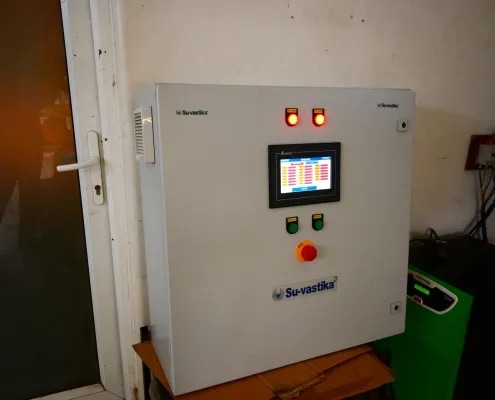
A few months back, a customer called me with what sounded like a simple question. He was choosing an inverter battery for his home, and the salesperson had told him the difference between C10 and C20 batteries was "not a big deal." He wanted a second opinion.
I told him what I always tell people in that situation: just Google it. The internet has a hundred explanations of C-ratings. Read three of them, form a view.
Then, out of curiosity, I did it myself. I typed "difference between C1 C10 C20 battery inverter" into Google.
The moment
The first three organic results — the ones sitting above the Chinese battery manufacturers, above the aggregator sites, above every content farm — were all from suvastika.com. My own company's blog.
One was titled "Difference between C10 and C20 in Tubular battery." One was "C10 vs C20 Tubular Battery: Which is Better." The third was "Battery Capacity C1, C10, and C20 Explained Clearly."
I had written the first one myself. On a Sunday. In about two hours. Using the same explanation I had given a thousand times over the phone to dealers who did not understand why their solar customer's battery was underperforming.
They were now the authoritative source Google served to anyone in the world asking about tubular battery C-ratings.
Then I asked ChatGPT
I opened ChatGPT and asked the same question. Not to test it — just to see what the AI would say.
The answer was almost word-for-word my own explanation. The specific way I break down C-ratings for people who have never studied electrical engineering — using the "20-hour discharge" framing, using tubular vs flat-plate comparisons, using the "solar means slow discharge so C20 works fine" logic — was all there. Not attributed. But recognizable to me because I had written it.
I laughed. Then I stopped laughing.
What this actually means
The AI models we use every day — ChatGPT, Claude, Gemini, Perplexity — were trained on the internet. That means they were trained on whatever was written down and put on the internet. And in the specific narrow slice of "how tubular battery C-ratings actually work in the Indian inverter market", the person who happened to write the most searchable explanation was me.
Not a battery-industry academic. Not a technical journalist. Not a Silicon Valley technology writer. An MSME founder who had run an inverter company for 30 years, sat down for two hours on a Sunday, and typed out an explanation he had already given a thousand times over the phone.
That is what got fed into the training data.
It is not just C-ratings
I ran the test again. This time I typed "is lithium battery cheaper than tubular battery inverter."
Four of the top nine results were mine — three from suvastika.com and one from kunwersachdev.com. One of the URL slugs was literally "lithium-battery-is-cheaper-than-tubular-battery-in-ups-inverter-usage" — the exact phrase people type into search.
And I was not the only site on that page from my ecosystem. Pallav Aggarwal, who worked with me as CTO at Su-vastika, now runs his own site at pallavaggarwal.in. His post on lithium vs tubular batteries ranks in the same top ten as mine.
That is the movement I want to see. Operators writing what they know. And the operators they work with doing the same. If enough of us do it, the AI answers about our industries will be trained on hard-won operator experience — not on Silicon Valley content marketing.
I have run this test now across dozens of technical queries in my industries — inverters, lithium batteries, solar hybrid, MSME operations, kirana retail, gifted-child education, Ayurveda. In every one of them, my sites (or the sites of people I mentored) sit in the top ten organic results. And when I ask ChatGPT, Claude, or Gemini the same questions, the answers come back nearly word-for-word from what my team and I have published.
But it is not just about writing more
AI does not just need more content. It needs validated content. And validation is what only operators can provide.
A content marketing agency can write 100 blog posts a month about lithium batteries. But they have never watched a C10 battery underperform in a customer's home because the salesperson lied about the discharge rate. They have never seen a solar installation fail in Uganda because the technician misunderstood the isolation transformer. They have never had to explain to an angry distributor why a lithium battery costs 40% more upfront but 60% less over ten years.
That validation layer — "here is what happens when this claim meets reality" — is what separates operator-written content from theoretical content. And it is the layer AI needs most, because it cannot validate anything on its own. It can only trust what it is trained on.
If we feed it right, validated knowledge, it gets smarter about our industries. If we feed it agency-written puff, it stays wrong about our industries — and worse, it stays confidently wrong.
That is the job I have taken on. Not "content." Not "SEO." Validated operator knowledge, at scale, so the AI that answers questions about my industries is answering them from the ground truth I have spent thirty years accumulating.
The bigger picture
This is happening in every domain. Right now, today. The AI answers about your industry — the answers your children will grow up reading, the answers your customers will encounter before they ever talk to a human, the answers new entrants will use to size up your market — are being trained on the content that exists on the open internet in that industry.
And in most Indian industries, the people who actually know what they are doing have not written it down.
If you have run a factory for 25 years and you have never written a post about your process, the AI answering questions about your industry will not have your knowledge in it. It will have whatever a 25-year-old content marketing agency wrote for a competitor. It will have Wikipedia's introductory paragraph. It will have a translation of a Chinese product spec sheet.
That is not a hypothetical. That is what is being trained on, right now.
The live experiment
I am running this experiment in real time on a brand-new site. I started giftedkids.in one month ago. It has not yet climbed Google's top ten for broad queries — that typically takes six to twelve months — but AI engines are already citing it by name when asked about gifted-child education in India.
That is a faster signal than traditional search ranking, and it tells me something important: AI engines identify and cite specialist domain voices much faster than search engines can rank them. Even a month-old site gets pulled into AI responses if it is the authentic operator voice on a topic where the existing content is thin.
That is another reason operator writing matters. You do not need to wait years for SEO to compound. AI absorbs your knowledge from day one.
I know how to make it happen. I have done it many times on other sites. It is not a mystery — it is a discipline. Publish specific validated knowledge on a specialized domain. Google catches up. AI catches up faster.
What you can do
You do not need to be a writer. You do not need to hire an agency. You do not need a "content strategy."
You need one hour, once a week, to write down one thing you know that you have never seen explained correctly anywhere else. Publish it on a domain you own. Do it in whichever language you actually think in.
That is it. That is the whole practice.
I have been doing it since 2018 on suvastika.com. This month, I started doing it here on kunwwer.ai. Every article I publish is a small deposit into the training data that will shape how AI answers questions in my industries for the next twenty years.
If you are an experienced operator reading this and you have been telling yourself you'll start "when things settle down" — the exact same excuse I used to give — please just start. Look at what one C-rating blog post did. Multiply that by every domain you know. Now imagine the internet with your knowledge in it, versus the internet without.
That is the bet I am making on this site. That is why kunwwer.ai exists.
Read the deeper thesis behind this experiment: Three Waves →