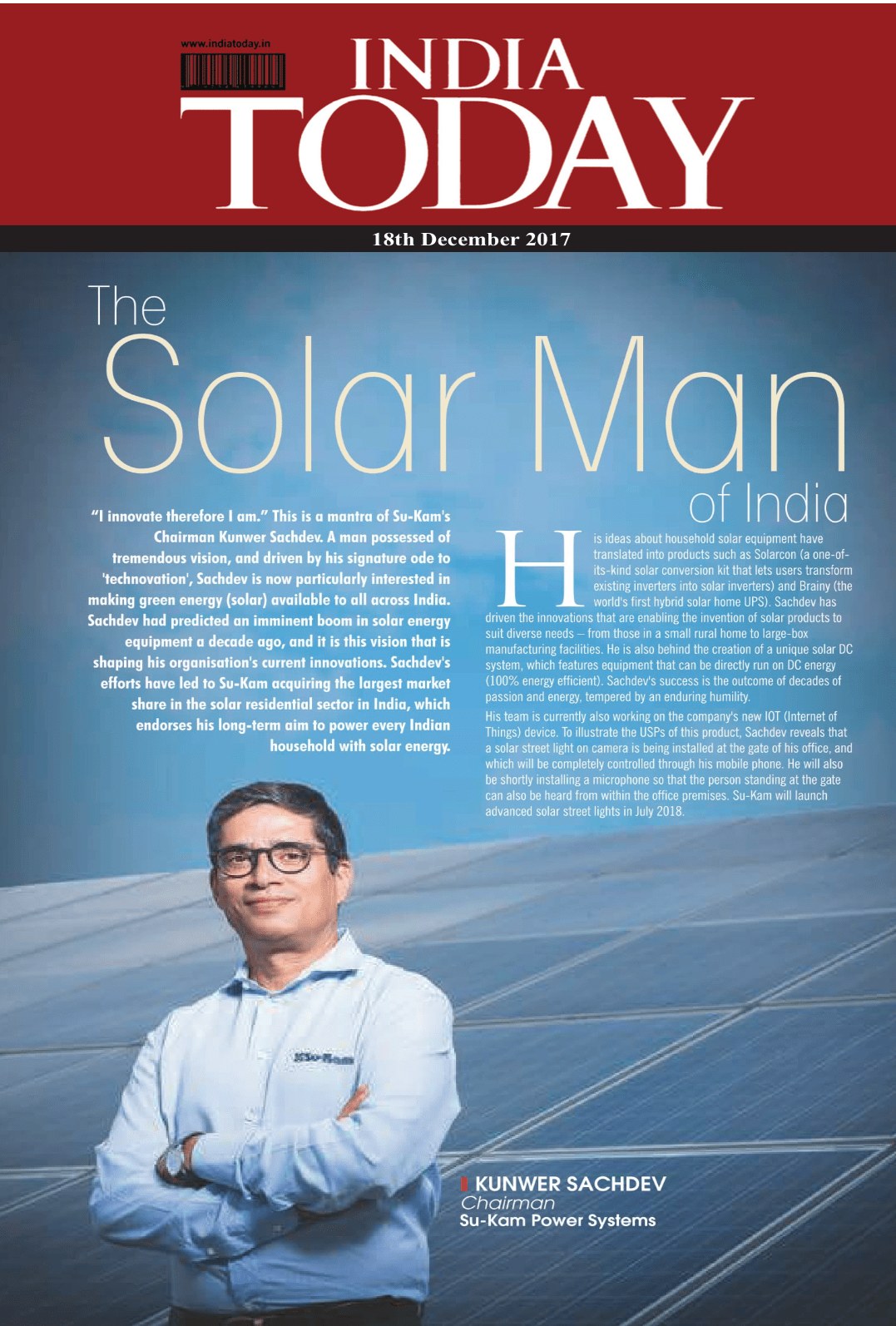
When I started Su-Kam in 1988, the plan was simple: build a good product, place a full-page ad in The Economic Times, and the phone would ring. That was how the market moved. If Business World profiled you, dealers listened. If Doordarshan aired your product on the evening news, distributors called the next morning. The trade press was the market.
I ran that playbook for fifteen years. It worked. By 2003, we had 200 dealers across India and Su-Kam was a household name in inverters.
Then it stopped working.
Wave 1 — Digital ate old media
By 2005, the ad in The Economic Times was still expensive but was moving fewer phones. By 2010, I was watching my dealer network's kids doing all their product research on Facebook and Google. The younger buyers were not reading Business World — they were reading someone's WhatsApp forward.
I could have complained. I could have hired an agency. Both would have failed, because the shift was too deep to outsource. So I did what I have always done — I sat down at the desk and learned it myself.
WordPress first. Then Google Ads. Then Facebook, YouTube, LinkedIn. I read every book I could find on digital marketing. I made bad landing pages, watched them fail, made better ones. I hired young people who had grown up on the internet, and I let them teach me what a "conversion" was and why a bounce rate mattered. The dealer meets I used to fly across India to run — I moved half of them onto webinars. The trade press I used to court — I started publishing my own posts, my own videos, my own newsletters.
By 2015, Su-Kam had a real digital operation. Not because I was a "digital native" — I had never touched a CMS in my life — but because I refused to be disrupted from the outside. I disrupted myself into digital before the market forced me to.
That is Wave 1. Digital ate old media, and every operator who built before 2005 had two choices: learn it, or lose relevance. Most Indian founders my age chose the second. I chose the first, and it kept the business alive for another decade.
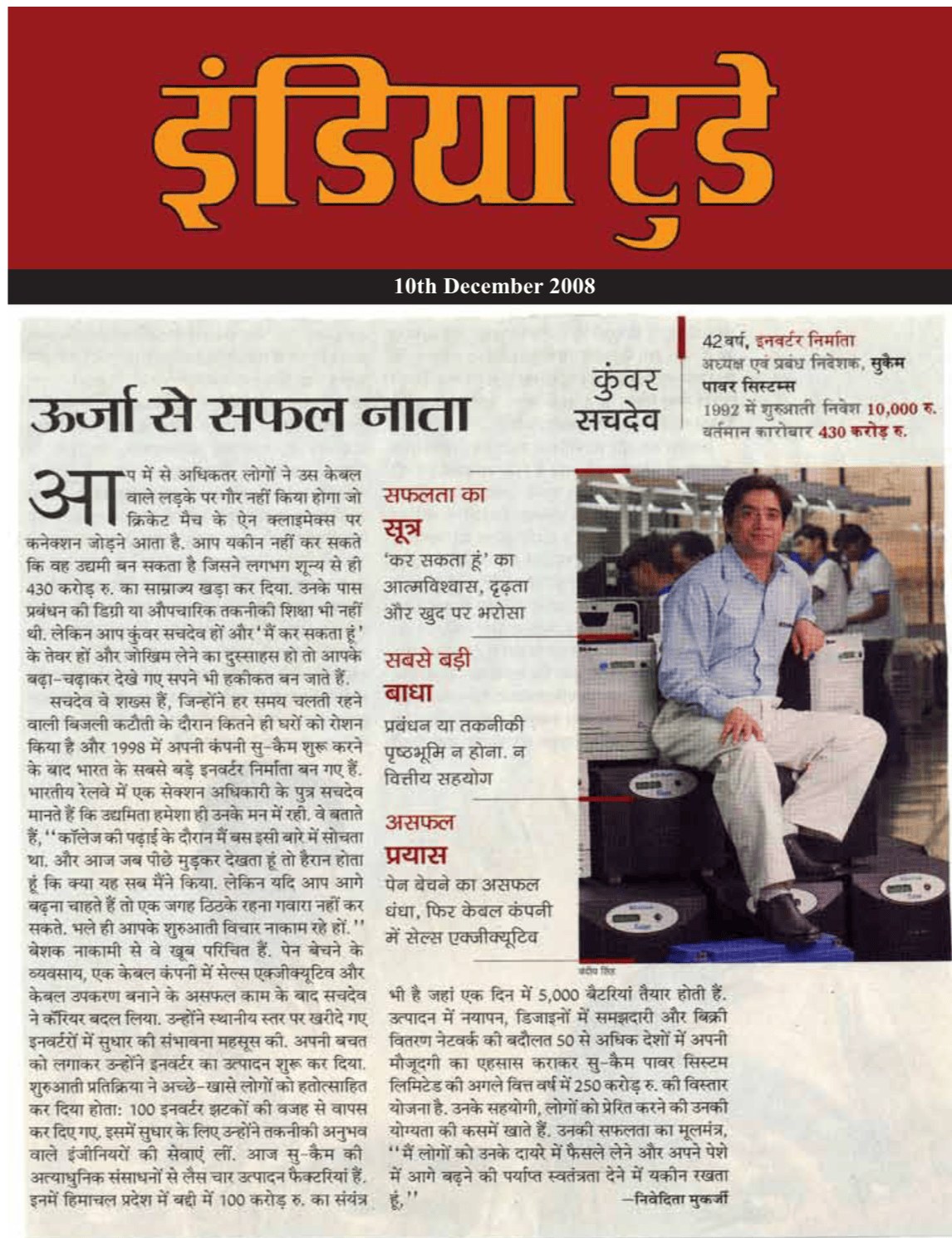
Wave 1 — print still mattered: India Today Hindi, 10 December 2008
Wave 2 — AI is eating digital
Now it is happening again. One layer deeper.
The WordPress sites I taught myself to build are being drafted by AI in twenty minutes. The dealer WhatsApp messages I used to hand-craft are being written by ChatGPT. The keyword research I paid consultants ₹50,000 a month for is now a $20 API subscription. The bounce-rate analysis I learned to read is being replaced by AI dashboards that just tell you what to fix.
Anyone who thinks this is a phase is going to lose. I have seen this exact movie once before, and I know how it ends.
The founders who ignored digital in 2010 did not disappear overnight. They had five more years of "the phone still ringing" before their businesses quietly rotted from underneath them. By 2018, half of them were gone, and the other half were selling to competitors who had done the work.
The same thing is happening to digital-native founders today. The ones who think their SEO agency, their WordPress site, their Facebook ad account, and their content team are a moat — they are wrong. Every layer of that stack is being eaten by AI, right now, in real-time. The moat is not the tools. The moat is who is willing to sit down and learn the new tools before they are forced to.
I sat down and learned WordPress at 50. I am sitting down and learning AI now. Not because I want to become an AI engineer — I want to be able to use it well enough that when it eats another layer of the business, I am the one holding the shovel.
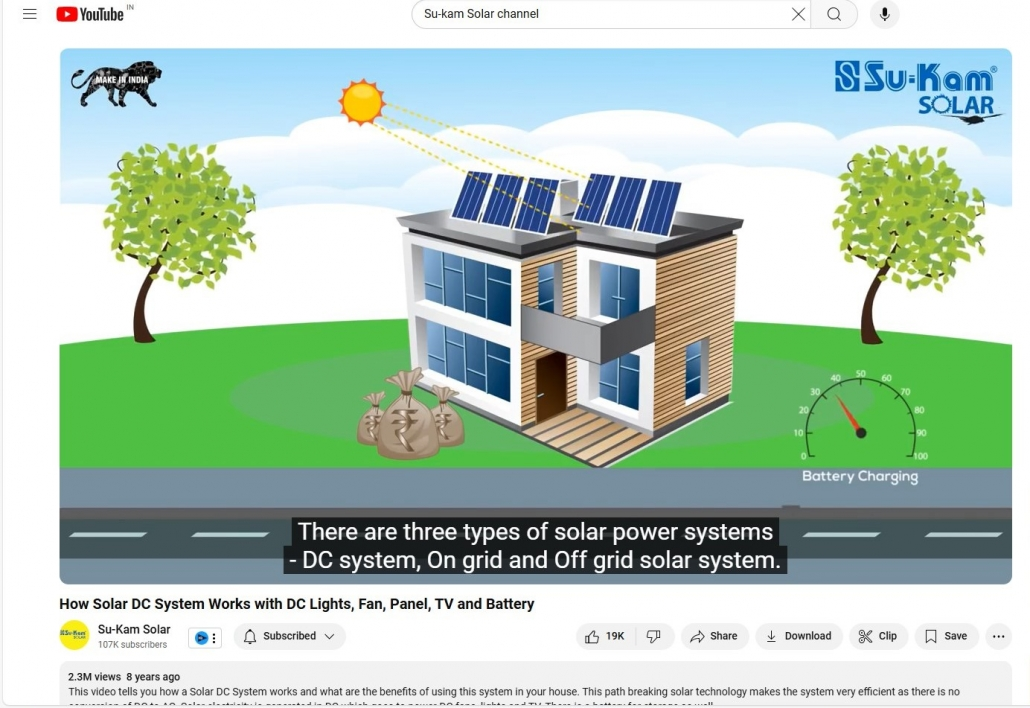
Wave 2 — digital: Su-Kam Solar on YouTube, teaching the market directly
Wave 3 — AI is coming for the physical world
But here is the thing most tech commentary misses. AI is not just eating digital media. It is coming for the physical world I know best.
Factories. HR. R&D. Purchase. Sales.
The MSME owner in Ludhiana who thinks AI is a Silicon Valley thing has no idea that his three-person HR team's job description will change more in the next three years than it has in the last thirty.
I see this every day, in the specialized sites I now run and in the manufacturing operations I still advise:
- The purchase manager who used to spend two days a week negotiating with vendors is now getting AI-drafted quotes in his inbox before he wakes up.
- The R&D engineer who used to test 20 prototypes is testing 200, because AI is generating design variations faster than the machine shop can print them.
- The sales rep who used to memorize a 40-page product spec is now getting a real-time whisper in his ear from an AI listening to the customer call.
- The HR team that used to take three weeks to shortlist 50 candidates for an engineering role now has a first-cut list of eight in an afternoon — and the eight are better than the shortlist used to be.
None of this is a prediction. All of it is already happening — in some factories in Pune, in some family businesses in Rajkot, in some distributor operations in Coimbatore. The MSMEs that are running these experiments are five years ahead of the ones that are not. And the gap is compounding.
That is what I write about on this site. Not "AI trends." Not "the future of work." Specific, small, boring transformations of factory floors, HR desks, and dealer counters — because that is where the real productivity gains are, and that is where I have spent my life.
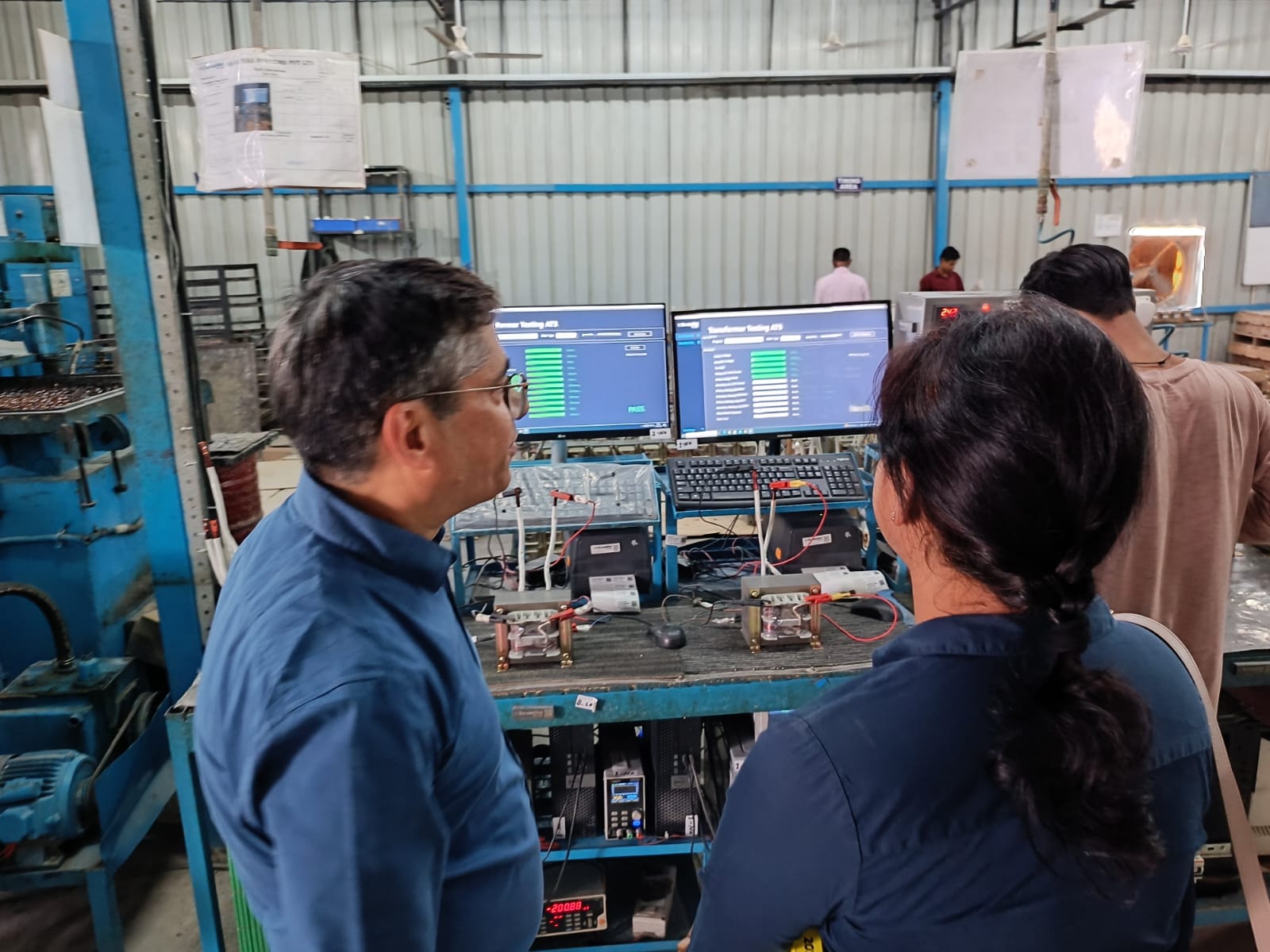
Wave 3 — software on the factory floor: transformer testing ATS at Su-Vastika
The knowledge has to come from somewhere
Here is the thing most people do not understand about AI: it does not actually know anything. It knows what it has been shown.
The models we use every day — ChatGPT, Claude, Gemini — were trained on the internet. Which means they were trained on whatever was written down and put on the internet. And a lot of what founders and operators know — the real, hard, in-the-factory knowledge — was never written down. It lived inside the heads of people who were too busy running the business to write.
That gap is now the biggest opportunity in the world.
Every experienced founder, every second-generation family business owner, every operator who has lived through a bank strike or a labour dispute or a customs raid or a distributor betrayal — sits on a body of knowledge that AI needs. Right now, the AI answering an MSME owner's question about how to structure a personal guarantee is trained on Silicon Valley VC blogs. It should be trained on the memory of the founder who signed one, lost his home, and rebuilt from zero.
That founder is me. And it is thousands of others like me.
The reason I write here — in English and in Hindi, on my own domain, with my name on it — is that the knowledge I have needs to be fed into the system before the system decides for itself what MSME advice looks like. If we operators do not write it down, someone with no operator experience will. And AI will learn from them, not from us.
This is not a philosophical point. It is a practical one. Every article I publish is a small deposit into the training data that will shape how the next generation of AI answers questions like "should I sign this personal guarantee?" or "how should I structure a dealer contract in Nigeria?" If enough of us write, the answers will get better. If we don't, the answers will get louder — and wrong.
So — if you are an experienced operator reading this — please start writing. Not for the audience of today. For the audience of tomorrow, which will be asking an AI.
Look — if you own an MSME in India, even a small one, ten employees, twenty years old, one product line — you already have domain expertise that AI engines desperately need. Whatever it is you make, distribute, service, or fix. Whatever specific problem you have solved a thousand times. Whatever war story you tell your son-in-law when he asks how to run the business. That is the exact knowledge AI cannot get anywhere else.
You do not need a degree in marketing. You do not need to be a "content creator." You need to spend one hour a week typing down what you know. In whatever language you actually think in.
That is the mission of this site — not just to write my own knowledge down, but to convince every MSME owner in India that they have knowledge worth writing down. And that AI engines are waiting to learn from them.
What I am actually building
This is not theoretical for me. I have already watched it happen. A blog post I wrote on suvastika.com — explaining the difference between C10 and C20 tubular batteries — now ranks in Google's top three organic results for that technical query, and shows up almost verbatim when you ask ChatGPT the same question. My writing is already training AI's answers about batteries.
Empirical proof. A few months ago I typed a battery specification into Google — and the answer that came back was my own writing. Read the full story →
That is why I am not just writing here. I am building a network of specialized knowledge sites — each one a domain-specific deposit for AI to learn from.
- kunwwer.ai — AI, digital, and MSME operations
- suvastika.com — inverter, lithium battery, and solar hybrid technology
- solarmanofindia.com — three decades of solar and power backup
- kunwersachdev.com — the founder's playbook, the personal archive
- kiranarating.com — trust and discovery for India's neighbourhood retail
- giftedkids.in — identifying and nurturing gifted children in India
- freeayurveda.com — traditional Indian medicine, open-access
- echogenie.com — audio-first tools for markets that skipped screens
- lithiuminverter.in — India's only independent LFP / EV / solar battery price tracker
- inverterindia.com — the working reference on Indian inverter markets
Ten sites. Ten specialized knowledge deposits. More coming.
Each one is a domain-specific section — because AI learns from the internet, and I want the answers about solar, MSMEs, kirana stores, gifted-child education, Ayurveda, lithium battery pricing, and inverter markets to come from someone who has actually done the work. Not from a Silicon Valley model spec-sheeting from stock images.
And here is the recursive part.
I could not maintain ten specialized knowledge sites on my own. Not with the writing volume required to actually rank, to actually be surfaced by AI, to actually feed the training data. I could barely maintain one before.
I can maintain all ten now because I use AI to help me write them. I draft with Claude. I fact-check with ChatGPT. I structure with Gemini. I let each model do what it is best at, and I edit every single line before it publishes.
Which means: AI is helping me create the knowledge that will train the next generation of AI. My thirty years of operator experience, filtered through AI's ability to draft and structure at speed, deposited back into the training corpus.
That is the loop. And it is available to any operator who wants to start running it.
The advice
I am not a technology journalist. I have never worked at a Silicon Valley company. I have never raised venture money. I built Su-Kam over three decades, watched two media waves reshape the market I sold into, and taught myself both of them the same way — by sitting down and doing the work.
This is the third wave. And this time, I am starting earlier — and I am writing it down.
If you own an MSME and you are on the fence about AI, I have exactly one piece of advice: do not wait for the third wave to force you. Sit down and learn it now. Look silly for six months. Ask 22-year-olds what they use. Try things that do not work. That is the exact same playbook I ran on digital in 2005, and it saved the business.
And if you are already past that stage — if you are an operator with twenty or thirty years of scars — start writing. This is the moment your knowledge matters most. The AI is being trained right now. Either you feed it, or it decides for itself what your industry looks like.
That is why this site exists.